HomeChapter IV
Chapter IV

How safe is it, really?

Two questions matter before any other: could this hurt you, and what does 'experimental' actually mean? Here is an honest accounting of both — and what still isn't settled.


Therapeutic dose is not wild infection.

For most of human history, people carried dozens — sometimes hundreds — of intestinal worms, acquired from contaminated water and soil. Those heavy infections caused real suffering: malnutrition, anaemia, stunted growth in children. That picture is not what helminthic therapy involves.

A typical starting hookworm dose is twenty-five larvae; many begin with fewer. None of the organisms used can reproduce inside the host — this is also what prevents any person-to-person spread. If needed, standard deworming medication clears them within days.

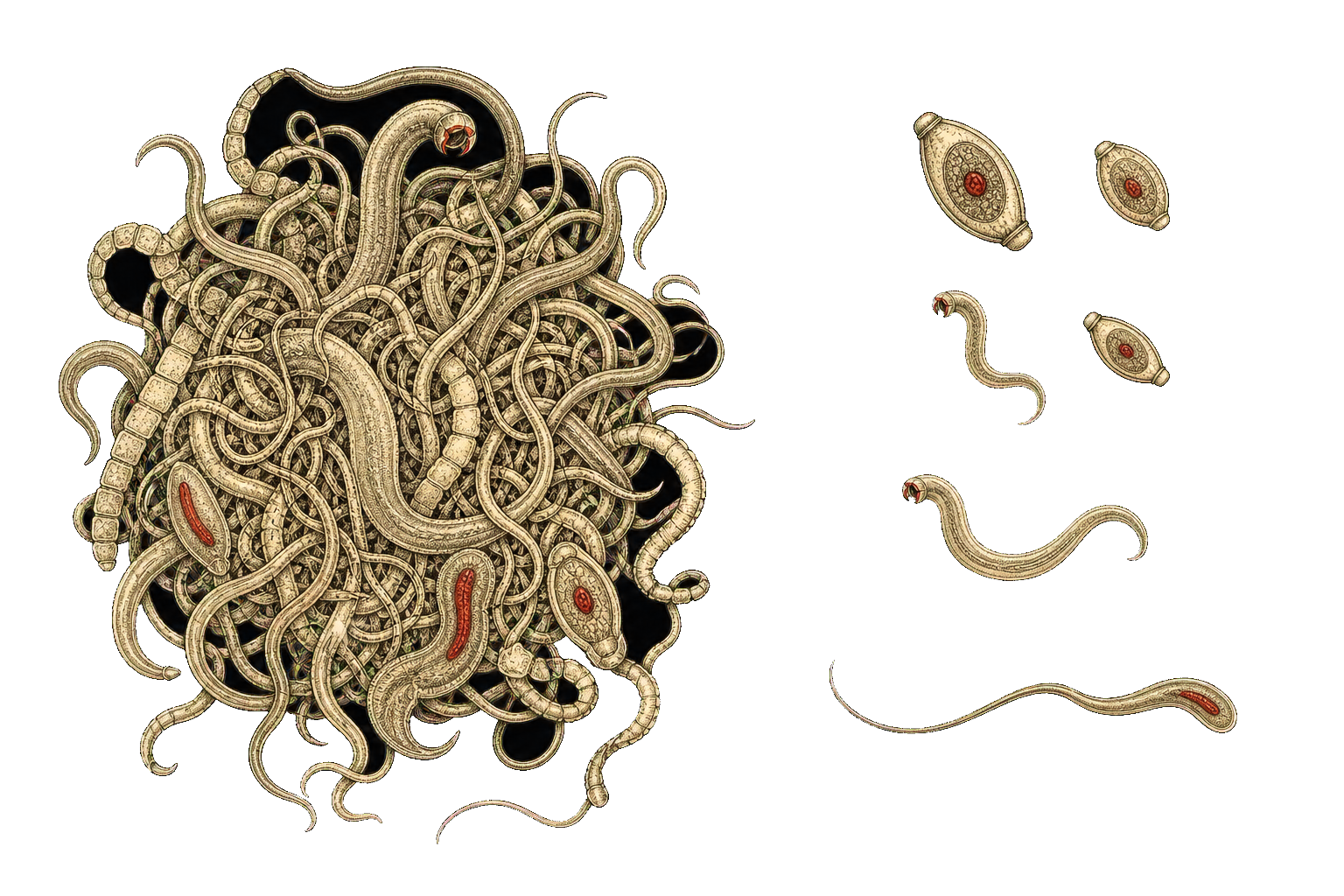
The illustration to the right holds both scales in the same frame. This distinction — between the weight of wild infection and the careful arithmetic of a therapeutic dose — is the most important thing to carry through this chapter.

Fig. 4
Wild infection versus therapeutic dose: two entirely different propositions.
Fig. 4Wild infection versus therapeutic dose: two entirely different propositions.

The evidence so far.

~75%

Within a large self-reporting patient community, roughly three in four eventually report some improvement. This is lived experience, not a controlled trial.

500+

Participants in formal university trials of human hookworm. No deaths observed.

6

Regulatory agencies — including the FDA and BfArm — independently cleared TSO for human trials before a single trial began.

2 yrs

When it helps, benefit can take many months to two years to appear. There is no quick version of this.

Safety analysis on the wiki

Unapproved is not untested.

No health authority has approved helminthic therapy as a treatment — organisms are supplied for research purposes. This is importantly different from saying the therapy has never been studied.

Pig whipworm (TSO) passed every safety evaluation required by the U.S. FDA, the German BfArm, and the equivalent agencies of Denmark, Switzerland, Austria and the Czech Republic before any of those agencies permitted human clinical trials to proceed. Those trials added further confirmation of safety. Human hookworm (NA) has been studied in formal trials at universities in the UK and Australia — across more than five hundred participants, with no deaths observed.

The Centers for Disease Control (CDC) classifies therapeutic hookworm doses as 'light' infections — a category they explicitly determine requires no treatment.

The immunologist William Parker, who has compiled the most rigorous dataset of self-treaters, puts it plainly: remaining helminth-free is not a neutral choice. The immune system missing its co-evolved companions is itself in a pro-inflammatory state — itself a risk. The question is not 'risk versus safety' but which risk, weighed carefully.

It seems highly likely that self-treatment with helminths, despite its unknown risks, is more beneficial than harmful to the average practitioner.

William Parker, Duke University — summarising 700+ documented cases of self-treatment
Safety on record
TSO safety clearances FDA, BfArm, Denmark, Switzerland, Austria, Czech Republic — all pre-trial
NA trial participants 500+ in formal university trials; no deaths observed
CDC classification 'Light' hookworm infection — no treatment required at therapeutic doses
Before you proceed.

This is precisely why a clinician belongs in the room. Some situations demand real care; a few are hard contraindications.

Severe immune compromise

Active HIV/AIDS or other serious, life-threatening infections. Immunosuppressive drugs taken to treat autoimmune or inflammatory disease are a different matter — most providers supply people on these medications.

Severe intestinal strictures

Hookworm larvae temporarily increase intestinal inflammation during initial colonisation, which could close a very narrow stricture.

Severely narrowed cardiac arteries

The temporary inflammatory response following initial introduction may exacerbate atherosclerosis.

Acute anaemia

Hookworms may modestly lower haemoglobin levels. Correct any existing anaemia first.

Pregnancy

The full discussion — including nuance for different organisms and trimesters — is on the wiki.

Diagnosed cancer

Providers may be reluctant to supply anyone in this situation, even in remission. Discuss with your oncologist first.

Full contraindication detail on the wiki

Continue · Chapter V

What doing this actually looks like.

In PracticeClinician packet